
Incorporating Play Into Trauma Therapy

Play is not the opposite of serious clinical work. For many trauma survivors, play can become a pathway back to flexibility, connection, embodiment, curiosity, and choice.
Trauma often narrows the nervous system toward survival. People may become highly vigilant, disconnected from spontaneity, rigid in roles, or fearful of uncertainty. Thoughtfully integrated play can help restore experiences of agency and relational safety without forcing direct trauma processing before the client is ready.
This does not mean minimizing pain or "making therapy fun." It means creating moments where the nervous system experiences:
experimentation without punishment
movement without hypervigilance
connection without performance
creativity without evaluation
uncertainty without danger

Why Play Matters in Trauma Work
Research in interpersonal neurobiology, attachment, and somatic trauma treatment suggests that play supports:
nervous system regulation
flexibility and resilience
social engagement activation
imagination and future orientation
embodied presence
corrective relational experiences
Trauma can interrupt developmental experiences tied to curiosity, spontaneity, and relational experimentation. Play reintroduces these capacities gently.
Trauma-Informed Principles for Using Play
Play in trauma therapy should always be invitational, collaborative, rather than therapist-directed, adaptable to sensory and access needs, paced according to nervous system capacity, and free from forced vulnerability or surprise exposure.
A client declining play is not resistance. Sometimes, seriousness has been protective.
Play should never become:
emotional bypassing
performative positivity
forced silliness
exposure disguised as "fun"
The goal is safety and flexibility, not entertainment.
Ways to Incorporate Play Into Trauma Therapy
1. Playful Externalization
Narrative therapy already creates space for creativity by separating people from problems.
Instead of:
"Why are you self-sabotaging?"
Try:
"What tricks does Anxiety use to convince you to disappear?"
Clients may:
draw the problem
give the problem a character voice
describe its "favorite tactics"
create comic strips or metaphors
This can reduce shame while increasing reflective distance.
2. Improv-Based Flexibility Exercises
Gentle improv exercises can help clients practice spontaneity and tolerating uncertainty in manageable doses.
Examples:
collaborative storytelling one sentence at a time
"Yes, and" exercises around preferred identities
role reversals
creating absurdly exaggerated coping strategies together
Example:
"If Perfectionism became a motivational speaker, what would its slogan be?"
Humor can create distance from rigid trauma narratives while strengthening connection.
For trauma survivors, the therapeutic value is often not the joke itself. It is surviving uncertainty while remaining connected.
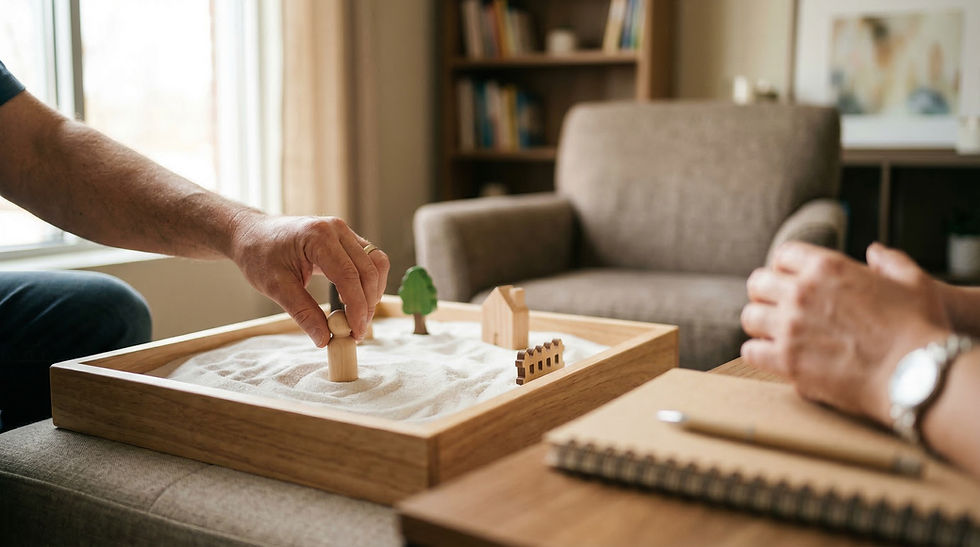
3. Sand Tray, Miniatures, and Symbolic Play
Symbolic play allows expression without requiring purely verbal processing.
Clients can:
map internal systems
represent trauma responses spatially
create safety scenes
visualize boundaries or supports
This is especially helpful for:
developmental trauma
dissociation
neurodivergent clients
clients with limited verbal access during activation
4. Creative Arts and Low-Stakes Making
Trauma therapy can include:
collage
playlist creation
zines
movement
puppets
watercolor
comic creation
character building
storytelling games
The emphasis is on process over product.
Low-stakes creativity can interrupt perfectionism and reconnect clients with agency.
5. Movement and Embodied Play
Embodied play may include:
tossing a ball during grounding
rhythm games
stretching with imagination prompts
playful bilateral movement
mirroring exercises
dancing
cooperative games
For many trauma survivors, especially those with chronic hypervigilance, movement that is not productivity-based can feel radically unfamiliar. It is important to go slowly, as body-based trauma can be tightly held and released in a way that feels flooding.
6. Reclaiming Joy as Resistance
For marginalized clients, play and joy may also carry political and cultural significance.
Systems of oppression often reduce people to survival.
Rest, creativity, laughter, and pleasure can become acts of reclamation.
Therapy can become a place where clients experience themselves as more than their suffering.
Questions To Explore
What forms of play felt safest growing up?
When did play stop feeling accessible?
What happens internally when things become spontaneous?
What kinds of creativity feel regulating versus overwhelming?
What does joy feel like in your body?
What identities emerge during play that disappear during survival mode?
Trauma-Informed Modifications
Some clients may experience play as unsafe, childish, chaotic, or dysregulating
Adaptations may include:
structured rather than open-ended activities
parallel play instead of interactive play
sensory accommodations
slower pacing
collaborative consent before exercises
allowing observation instead of participation
Play should widen the window of tolerance, not flood it.
Clinical Reflection
One of the quiet losses trauma can create is the loss of joy, playfulness, and improvisation. Clients may begin to experience life as something to survive correctly rather than inhabit creatively.
Incorporating play into trauma therapy is often about restoring possibility, connection, softness, and delight.
Sometimes healing looks less like "fixing" and more like helping clients rediscover the parts of themselves that trauma taught them to abandon. It is a gift to build safe ways to reclaim joy and play.


Comments